All thoughts necessarily need to begin with presuppositions, and the said presuppositions need to have propositions that are in essence non-contradictory.1 Each proposition is nevertheless delimiting in its essence. Negation, therefore, of the said proposition becomes a necessary movement in pure logic 2; following this line of thought, and as Heidegger concluded in questions concerning technology, questioning is understood as the piety of thought. Socrates knew this all too well, and thus the guiding principle of 'logos' came into frame. This essay will then take a sharp right turn and will question the essence of questioning and thus try to uncover the very pseudo-humility that hides underneath.
Let us firstly look into the Greek philosopher Parmenides' thought. "One should both say and think that being is." 3
For the untrained eyes, these words appear to be an empty platitude; for the trained eyes, these words point towards a hall of mirrors with infinite reflections.
To understand Parmenides better, let us first take into question the nature of western thought, which is so far understood within Western metaphysics as an expression of idea. As summed up by the sad prince of pessimism:
"The world is my idea (re-"presentation"): this is a truth that holds good for everything that lives and knows, though man alone can bring it into reflective and abstract consciousness."
-Arthur Schophenhauer, The World as Will and representation Vol.1, E.F.J Payne Translation.
This is also beautifully depicted within René Magritte's La condition humaine 5
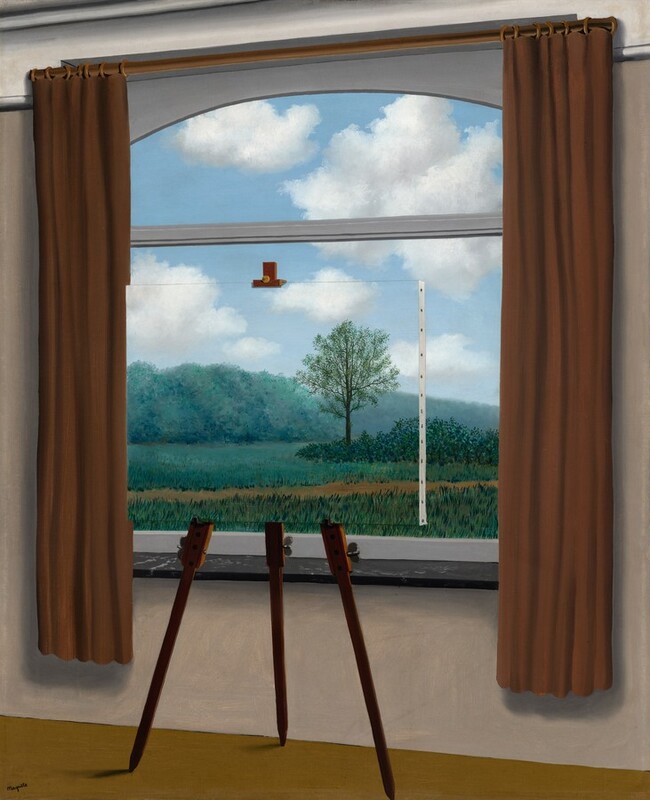
To have an idea is to then be face-to-face, which then appears to be other than ourselves; we never see a tree as 'is,' 4 but rather we bring forth the idea of a tree through a form of objectification. This objectification then leads to a pigeonholing of the tree into a bounded 'what' defined by everything it is 'not'. For instance, To make the metaphysical claim, "The tree is green," would then be to neglect the infinitude of thought that makes up the tree. One can understand then that this picture of thinking as an expression of idea(re-"presentation") is by its nature incomplete.
Strictly speaking, experience does not present us with a pure subject confronting a pure object. These are distinctions indo-european grammar, and by larger extend ego-consiousness, makes as it encounters, enacts and brings forth the world. To recognize their limits, we must nevertheless begin from within them: attend to ourselves and to what appears, while resisting the impulse to treat the moment chiefly as something to use, categorize into neat boxes. Viewing things purely through their utility is superficial and thereby objectifying them. The question then at any given moment would not be "How can I use this situation?" instead "How can be aware of it more fully, without making my own act of attention its center?" (How do "I" empty the sense of I-ness?) Phenomenology, through its careful qualitative description of experience, may help us approach this question. And lead us therewith to greater reason, greater heights and better views.
All great thoughts (in my intrepertation) have little to no concern of whatever concerns the zeitgeist at any given point; these thoughts are by their nature free from temporal abstractions and quantities and thereby independent of time. Such thoughts and individuals are then celebrated posthumously if at all. Thinking, from this vantage point, has more in relation to poetry than it has to with pure logic. One needs to learn to hold contradictory beliefs without the tendency to fall to neat conclusions, abstractions, and reconciliations; 6, contrasted with the Hegelian Aufhebung, which requires every contradiction to be neatly resolved to a higher synthesis.
Grace in movement, economy of speech, slow judgment, and true epistemological humility are thus foremost spiritual qualities within a person. This is, however, not a normative claim but rather a way of pointing towards transfiguration, an invitation for 'Transmutare materiam primam in animam mundi.'
True epistemological humility distinguishes itself from pseudo-humility through its relation to speech. Pseudo-humility declares itself, makes itself explicit, genuine humility remains implicit. It does not need to constantly announce its modesty; it doesn't need the loudness of "I know that I know nothing" because it is expressed in the economy of its speech, in its willingness to remain silent, and in its refusal to convert uncertainty into the explicit nature of abstractions. Blessed, then, is the one who speaks only so as to protect silence.
-
Aristotle, Metaphysics Γ.3-4 (1005b-1007b). He calls non-contradiction the firmest principle, one that cannot be demonstrated, only defended by refuting its opponent. ↩
-
Spinoza, Letter 50 to Jelles: omnis determinatio est negatio. Hegel develops this as "determinate negation" in the Science of Logic (Book I, on Determinate Being). ↩
-
DK 28 B6.1. The Greek (chrē to legein te noein t' eon emmenai) is notoriously ambiguous, and translations vary: "it is necessary to say and think that what is, is." ↩
-
Kant, Critique of Pure Reason A598/B626 ("being is not a real predicate"). ↩
-
Attribution : La condition humaine, 1933, René Magritte; https://www.nga.gov/artworks/70170-la-condition-humaine ↩
-
Keats's "negative capability" (letter to George and Tom Keats, 21 Dec 1817). F. Scott Fitzgerald, "The Crack-Up" (1936), on holding two opposed ideas. ↩