The usage of the word 'subconscious,' developed by Pierre Janet, for reasons (un)known easily became pop culture lingo that takes the unconscious forces of the mind as inferior to the conscious mind. This usage primarily concerns me for reasons beyond mere linguistic pedantry.
Firstly, the usage is shown to imply the "subconscious" mind as a form of untrained, animalistic mind in favor of the supposedly superior, civilized conscious mind. Reflecting the age of reason's assumption that humans are rational beings with complete control over their fates, it's a disguised form of human centrism and a veiled god complex. The term is also unanimously rejected by the (in)famous psychoanalytic trio Freud, Jung, and Lacan. A disturbed form of conscious thought has always been largely superficial since the beginning of time.
Etymologically, it takes the same meaning of inferiority as well; 'sub-' implies 'inferior.' On the contrary, the unconscious mind is superior to the conscious mind. It excels in non-linear thinking, bridging conceptual leaps, gestalt (non-categorical) pattern recognition, and complex mathematical insights. As observed in thinkers embodying this ideal of mathematician and scientist, such as Ramanujan, Tesla, and Einstein. This form of 'releasement' from conscious-analytic thinking becomes more visible in esoteric traditions and even philosophers like Nietzsche and Kierkegaard. Anti-totalizing systems and non-idealist thinkers like Adorno, Deleuze, and Guattari can be seen questioning the validity of Western reason and linear-conscious thinking as well.
Whether the modern mind accepts this or not, non-ordinary states of consciousness have always been the leading factor towards a 'singular' idea of progress, not to be confused with the idea of naive historical progress as championed by materialists. But towards a "naive" revitalization of the heterogeneous nature of the spirit, a new form of reception from the "muses" and "gods" is not to be confused with romanticizing the past. But a love for the artists that can balance the antagonizing forces of empirical reality while still being able to build the substance of art through a "subliminal" form of empirical reality. Every artist at the end of the day takes a dissent to the "Labyrinth of the breast," to use Goethe's term.
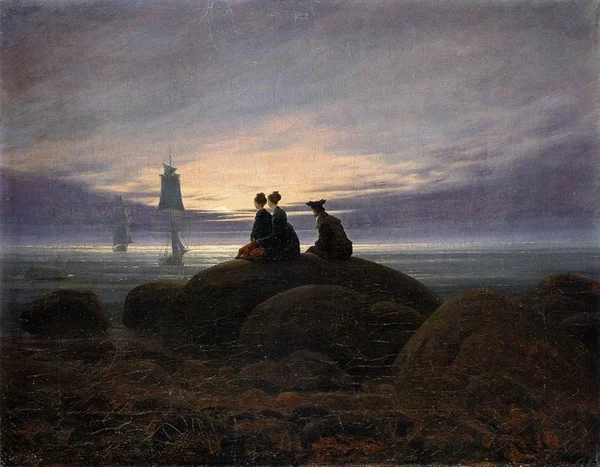
Was von Menschen nicht gewusst,
Oder nicht bedacht,
Durch das Labyrinth der Brust
Wandelt in der Nacht.
I am not merely inverting the value of the "unconscious" here...but defending a love for the ephemeral, the impermanent, and the eternal feminine, finding the field of liminality and permeability between the conscious and the unconscious states, a love for the moon and the earth and that which is unknown and enigmatic. An uncertainity within uncertainity.
Am I being self-refuting here? Perhaps, but I like it that way. The dance of contradictions is only a hindrance for the intellectually dishonest and for those who view life as a zero-sum game.
And the irony is always there. Can you live without a manifesto?