The nature of consciousness is essentially reactionary, a reaction to external forces. As Heidegger notes, we are "thrown1" into the world; therefore, the advancement of human consciousness brings forth a world through our reaction to the 'other'. It seems human consciousness emerged primarily from the need to communicate. Human reason came about from this social need as well and is thereby an interpretative tool, which helps us communicate with the other.
However, as the Frankfurt School thinkers have warned, this advancement of reason took a dangerous turn towards a new form of barbarism, ultimately losing its self-critical nature. In their Philosophical Fragments 'Dialectic of Enlightenment', Adorno and Horkheimer stated the following:
"Enlightenment, understood in the widest sense as the advance of thought, has always aimed at liberating human beings from fear and installing them as masters. Yet the wholly enlightened earth is radiant with triumphant calamity. For enlightenment, anything which does not conform to the standard of calculability and utility must be viewed with suspicion... Enlightenment is totalitarian."
Numbers became the ultimate canon for the bourgeoisie. Quantification operates as the tyranny of the herd: anything irreducible to quantities, that which cannot be atomised, commodified, scaled, measured, seen, or touched, is dismissed as mere illusion. The non-identical and the different are subjected to the homogenising forces of the collective and are ultimately cast out or exiled.
Diverging from the romantic movement of the 18th century, however, it is not this reducible nature of reason to quantities that creates this flattening and equalising effect. But rather from the naive assumption that the trial of reason is free from prejudgement. Instrumental reason, which can be seen as the mechanisation and objectification of thought, is thus a tool of capitalism and the market economy. They are totalitarian, fascist, and patriarchal in the broadest and most meaningful sense.
When gods could not save us from the fear of the unknown, reason, through its reified, cold rays, equally feared this unknown. What came about was a disenchantment of the world; all myths are subjected to demystification, stripped of their beauty and qualitative depth. Modern-day superstition is therefore not found in the absence of reason; it is the direct byproduct of reason, arising from its own delimiting nature.
Comparing these ideas to our day and age. The "Quantified Self" movement represents the ultimate culmination of capitalism. Humans are atomised, reduced to scalable numbers and DNA strands, with figures like Bryan Johnson embodying the extreme end of this obsession.
Quantification is a bloody untruth; it is capitalism's trump card. The maxim "more is better" is a logical superstition, an empty utilitarian ideal masquerading as progress.
This can be understood through the colonisation of English. Language's task is approximation. Paradoxically, the more poetic language becomes, the more concrete it is. Here we see how language shapes our thought and reality. The global domination of modern spoken English anticipates this utilitarian fantasy becoming a global reality. Words, when they get stripped out of their mythopoetic and antique beauty, end up being designed for speed and superficiality.
A non-capitalistic revolution would then require grammatical dissolution of the subject-object dichotomy while retaining human agency and a slow but gradual destruction of the subject-verb agreement of Indo-European languages. In favour of grammatical structures that revolve around interrelational processes and flow-oriented dynamics. This should be done with careful consideration of historical, social and material conditions. But I am getting ahead of myself here.
Through The Concept of Anxiety, written under the pseudonym Vigilius Haufniensis, Søren Kierkegaard undertook the Herculean task of explaining psychological concepts like anxiety, original sin, and hereditary sin through philosophical deliberation. The language used in this book is dialectical. The obscurity that accompanies the text should be read as dry satire rather than grammatical confusion or pretentious, wilful obscurity. Furthermore, we will connect his critique of the state church, Christendom, organised religion and modernity to the contemporary critique of capitalism and the tyranny of the masses.
Kierkegaard is one of the few Christian theologians who rejected the traditional concept of liberum arbitrium (free will), calling it a conceptual monstrosity. After all, how can freedom be temporally, spatially, and finitely defined? Free will is an oxymoron. He also distanced himself from the Calvinists by denying that the world came into existence by pure necessity alone.
While he defended the freedom of the sovereign individual through a form of inwardness and openness (not to be confused with the reserved mind). Kierkegaard inverted traditional Christendom's belief that the Christian mission is a move towards the universal; instead, he argued Christianity is a move towards the particular.
Not to diverge further, Kierkegaard explains that the real possibility of sin originates when the single individual posits themselves as a single individual. Adam, of course, did not truly understand the difference between good and evil, as this distinction only followed the enjoyment of the forbidden fruit. The individual becomes guilty only through themselves; punishment cannot create this internal guilt. His father's words, "Thou shalt know death," did not create the effect of guilt within him.
Regarding the historical beginnings of hereditary sin: for Kierkegaard, the story of Genesis provides the only dialectically consistent account for the origin of the particular. (I have my disagreements here, as pagan religions also offer accounts explaining the nature of the fall and human sinfulness by positing an infinite qualitative gap between temporal human existence and the eternal cosmos).
Adam is the only figure in whom a prior sinful nature is absent, for it was through him that it came into being. In this, Adam differs essentially from the human race, yet without him, there would be no human race; Adam is both himself and the race. The idea that prohibition raised his desire is a modern misconception; his sin came from a qualitative leap that accompanies overflowing abundance rather than from a state of lack.
Clearly, Adam did not understand the words that his father spoke, for they sounded obscure and alien to him. We infer here that anxiety from the words is the presupposition of the sin. Anxiety here does not belong to the category of 'fear' nor the category of 'necessity', which the English language attributes it to.
Anxiety here came with the possibility of possibility. Freedom that came with the possibility of the individual to posit itself. We must tread carefully here to avoid promoting the Augustinian idea that "free will" created the problem of evil. As previously discussed, free will is a logical impossibility; the concept of "freedom" cannot exist within a purely external, temporal, and finite framework. Kierkegaard proposes to sit with the feeling of uneasiness, which accompanies the feeling of anxiety, as a form of inwardness and suggests building a rich inner life of certitude. Not to resort to empty busyness and tedious spiritlessness.
This inwardness should not be confused with a vegetative, unproductive state. Since humans are the synthesis of the body and the soul, they possess the character of the spirit. Spirit would nevertheless posit its own freedom and take action, like the analogy of a self-propelling wheel. No humans are thereby created with a meaningless superfluity. Everyone has something that is to be contributed to eternity and the race in a qualitative fashion. Every individual has the possibility to bring something new, that which is entirely them, into the world.
The difference between Adam and the later individual lies in the form in which sin is posited. Adam's sin was qualitative, while hereditary sin is quantitative. This new quality appears via a leap, with the suddenness of the enigmatic. This suddenness is the qualitative leap itself. Sinfulness precedes the sin, multiplying itself through generations.
Sinfulness is the anticipation of infinite eternal possibilities, grasped while clinging to the temporality and finiteness of existence. In other words, sinfulness comes with eager longing for creation. As long as this eager state of longing exists, creation continues to live in a state of imperfection. Sinfulness is then a quantitative approximation of the human race. Objective anxiety is the eager longing of creation.
The human being, Kierkegaard explains, is at one and the same time both itself and the whole human race, so that the whole race participates in the individual and the individual in the whole race. Modern-day Christian philosopher obsession to explain the hereditary sin through logical axioms and mathematical gymnastics is, nevertheless, a foolish obsession.
The confusion, for Kierkegaard, lies not in science's not passionately dismissing foolish questions but, on the contrary, in confirming superstitious people in their notion that one day a scientist with all his cold-rational glory, a theory-monger, would come along who was man enough to use Bayesian theorem to find the existence of God and the nature of sin.
To understand the nature of sin, it is necessary to understand Adam's sin as the qualitative one.
Through the qualitative leap, the individual becomes guilty. This presupposition of the leap carries a double meaning: through sin, sensuousness becomes sinfulness, and through Adam, sin entered the world. Adam himself does not carry this sinful nature. The difference for all later individuals, in the nature of sin, is merely a derivation, though for the single individual, this derivation from Adam may be more or less so quantitatively.
Modesty arose as anxiety from the spirit feeling alien and comical. The spirit's expression of the erotic is that it is simultaneously beautiful and fraught. Just as anxiety is posited in modesty, it is present in all erotic enjoyment, not because it is inherently sinful but as an accompanying, disturbing factor. Even when the erotic is expressed as purely and beautifully as possible, undisturbed by modern lascivious reflection, anxiety remains. The spirit, however, cannot fully express itself in the erotic. It remains a third-party. Sensuousness itself, however, is not sinfulness. It becomes sinfulness through the individual when they posit themselves.
But if we were to call sin a form of selfishness in relation to the particular, it would mean that the universe revolves around the non-identical. The chief centrifugal force of life is that of selfishness, one of sin.
The Genius's existence is, however, one of sin, since he needs to posit himself qualitatively.
This is why the genius continually discovers fate, and the more profound the genius, the more profound the discovery of their fate. His existence itself is a form of rupture through which entire existence questions itself. Every genius is thus born in an untimely and out-of-place manner, and his greatest enemy and his favourite lover will always be his fate. Showing both his impotence in relation to actuality and omnipotence in relation to the Eternal.
A reserved individual, on the other hand, is filled with a bad conscience. They manifest as vengeance, involuntary outbursts, resentment, pettiness, and revenge. Reserve came into effect through a form of self-relation, a denial of his own individuality.
From a purely aesthetic perspective, this reserve is best captured by the character of Mephistopheles. Mephistopheles' leap through the window and remaining frozen mid-leap perfectly encapsulate modern depersonalisation, mimicry, and the quantification of the individual. Maybe one day I will write a book on Mephistopheles; I believe he is the best-written fictional character and the most philosophically convoluted one.
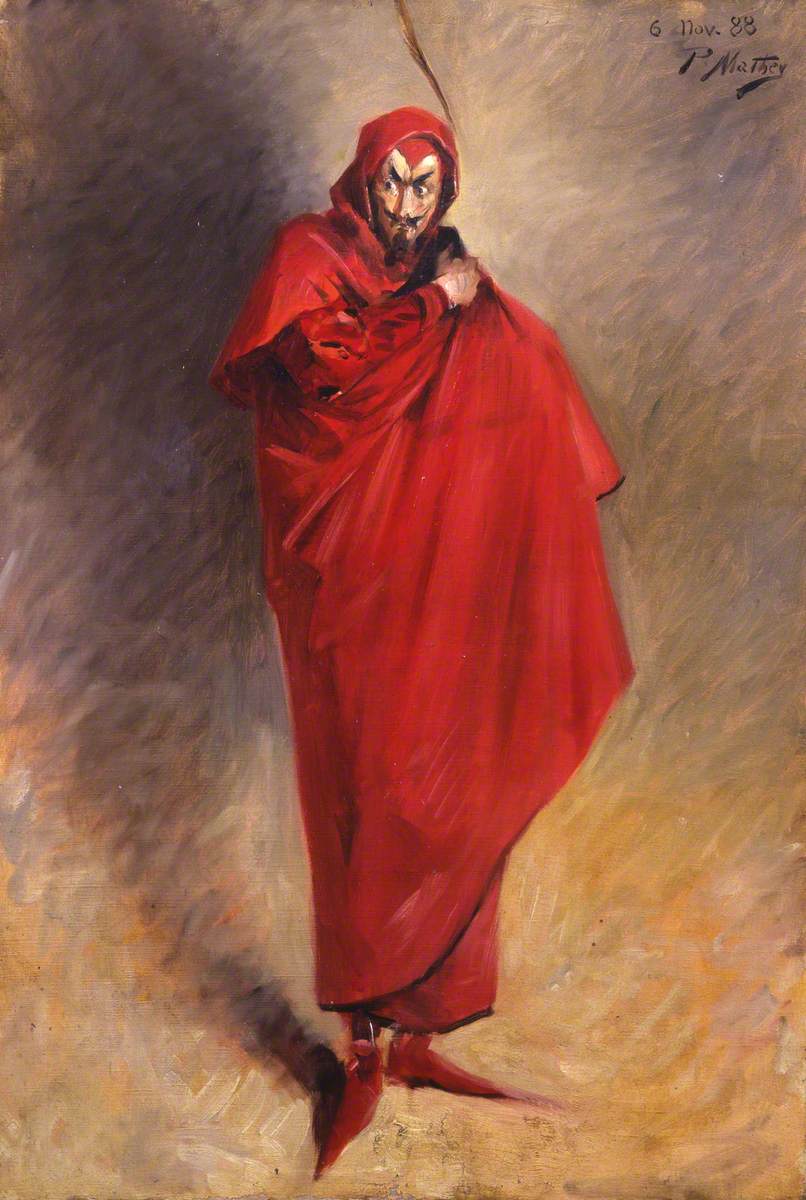
With that being said, I would like to offer a rebuttal regarding the feeling of sin. Even if the concept of sin is a concrete category in itself, the guilt arising from it is fundamentally an absence of freedom. Mind-body dualism does not exist, just as there is no doer behind the deed. As Nietzsche famously put it, we say "lightning flashes", but the lightning is the flashing; it cannot be anything other than the flash. The concept of the lightning, like the concept of the self, is a fiction invented to justify action. Your brain lies to you about the concept of the narrative self. In other news, the sky is blue.
Instead, the self consists of non-self elements determined by external factors: a core message of the Bhagavad Gita, fundamental Buddhist doctrine, and Nietzsche's deconstruction of the Cartesian thinking subject.
Nietzsche, Buddha, and Krishna converging on the single insight that the "thinking subject" is merely a category error is not a sentence I thought I would write, even though their intentions diverge radically from this insight. Further, I reject the notion that once sin is posited by the individual, it becomes inescapable. Anxiety and suffering are accompanying factors of life, but ones that can be transcended through affirmation of oneself. Maybe a form of inwardness through faith. But I view the word 'faith' with scepticism, since traditional faith needs a friend-or-foe relation with knowledge. At the end of it, one should be capable of dance, joy and laughter. Maybe I am not far from Kierkegaard in this definition of faith through passion.
And it is also important to not confuse the leap with the dance.
-
The concept of being "thrown" into the world (Geworfenheit) originates in his magnum opus Being and Time (1927). It describes the fundamental human condition of finding oneself already situated in a world with pre-existing historical, social, and material conditions, prior to any conscious choice. ↩